Context
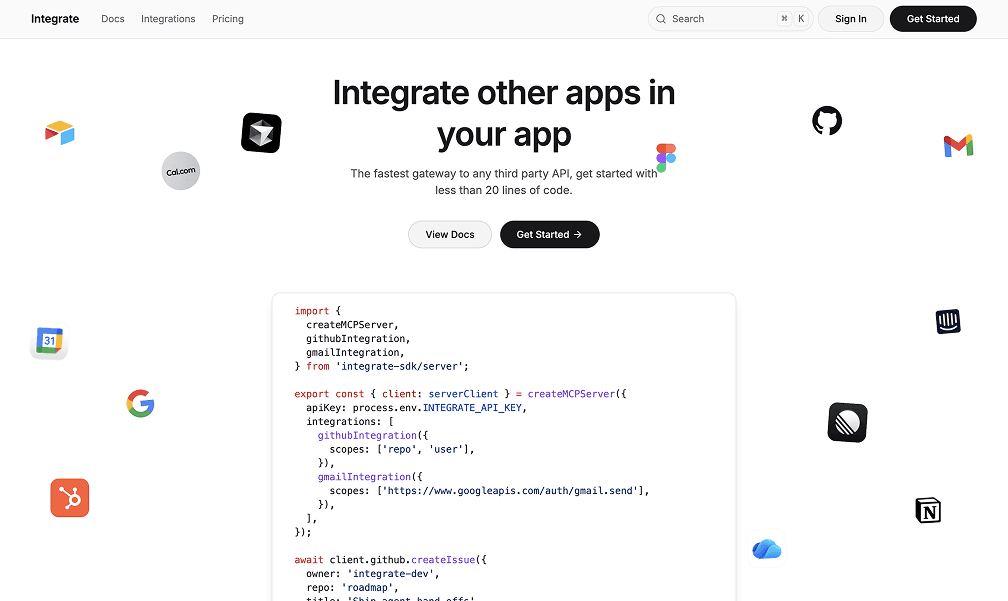
Integrate is an integration gateway for AI applications. The integratedotdev organization maintains an open TypeScript SDK, a Go MCP server, a dashboard, and examples, all oriented around MCP and OAuth.
The problem
AI products need secure, typed access to third-party APIs without every team reimplementing OAuth, session handling, tool registration, and MCP wiring. The solution had to work in browser and Node.js and feel native to modern AI SDKs.
How we approached it
We shipped integrate-sdk as a zero-dependency TypeScript client with integration-based APIs (e.g. client.github.createIssue()), built-in OAuth 2.0 with PKCE, scheduled triggers, and Next.js handlers via toNextJsHandler. The Go MCP server exposes Gmail, GitHub, and Notion tools with session tokens, rate limiting, and caching.
What shipped
- typescript-sdk: published patterns for MCP + OAuth (topics: mcp, ai, integrations)
- mcp-server: Go MCP server with OAuth flows and tool registry
- dashboard: operator UI at app.integrate.dev
- examples: reference implementations for adopters
Outcomes
- Developers enable integrations selectively instead of loading every connector
- Documented redirect URIs and catch-all API routes reduce setup time
- Public SDK README and server docs align with integrate.dev positioning
- Ongoing development through 2026 on the TypeScript SDK and MCP server
Stack
- TypeScript
- Go 1.24+
- Model Context Protocol (MCP)
- OAuth 2.0 + PKCE
- Next.js API routes
- Vercel AI SDK (consumer)
Public repositories
- integratedotdev/typescript-sdkintegrate-sdk on npm
- integratedotdev/examples